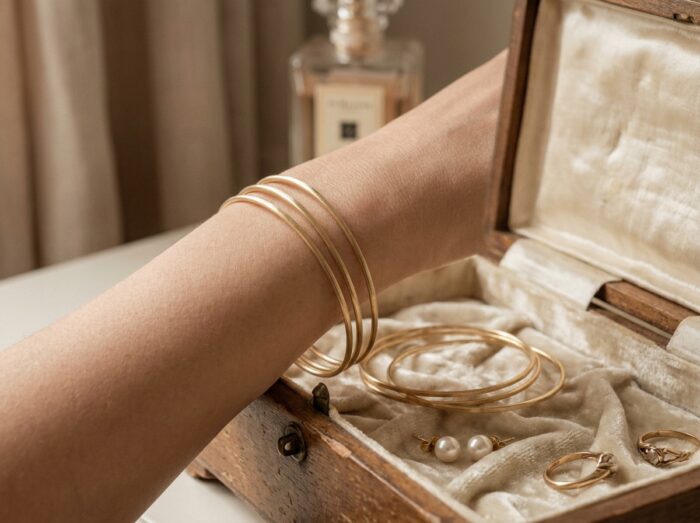
A thin bracelet in gold plating or 925 silver, worn for a few weeks, then relegated to the back of a drawer. We observe this scenario on repeat, and the reason rarely lies in style. The clasp breaks, the plating tarnishes, the chain tangles with three other pieces. The problem is technical before it is aesthetic.
Plating and metal grade: what condemns a thin bracelet to oblivion
A bracelet labeled “gold-plated” may rest on a base of brass or steel covered with a thin layer of precious metal. The thickness of the plating determines longevity, not the color in the display case. A coating that is too thin wears away with repeated contact with skin, textiles, and water.
The mention of “recycled gold” deserves the same vigilance. After refining, recycled metal retains the same chemical properties as new metal of the same grade. The question is therefore not “recycled or not,” but what grade, what thickness of plating, and what traceability. A solid 925 silver remains more reliable over time than a gold-plated piece on an uncertain base, even if the latter costs more.
To understand why thin bracelets in jewelry boxes accumulate so quickly, just look at the material sheet: when it is absent or vague, the jewelry has a limited lifespan.
Nickel and prolonged contact: the health criterion that product sheets evade

The European REACH regulation governs nickel emissions from items in prolonged contact with the skin. A thin bracelet worn daily falls into this category. Nickel is the primary contact allergen from metals, and once sensitization occurs, it is irreversible.
The choice of base metal is as important as the plating. Surgical stainless steel or 925 silver without added nickel rarely poses problems. In contrast, some cheap brass alloys contain notable proportions of nickel, which the gold finish completely masks.
We recommend checking two points before purchase:
- REACH compliance explicitly mentioned on the product sheet or label, not just in the site’s general terms.
- The composition of the base metal (not just the coating), especially for reactive skin or prolonged daily wear.
- The presence of a nickel migration test, which some artisanal manufacturers provide upon request.
Clasp and junction points: the weak link of the thin bracelet
A recurring testimony appears in customer feedback: the bracelet breaks after a few months, often at the clasp or junction ring. The clasp is the primary point of failure on a thin bracelet, well before the wear of the chain itself.
On a thin chain, a standard lobster clasp exerts disproportionate mechanical stress. Junction rings, if they are open and simply closed without welding, eventually pull apart under the repeated tension of the wrist.
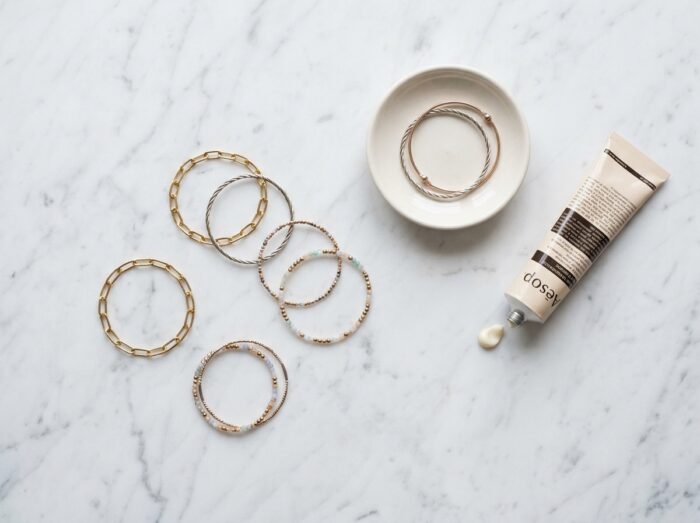
Here are some guidelines to assess the robustness of a clasp:
- A welded junction ring holds up significantly better than a simply bent ring, especially on thin links.
- A quality spring clasp (like a lobster clasp) should return to the closed position without lateral play.
- The manufacturer’s or retailer’s repair policy is as crucial a purchase criterion as price: a bracelet without a warranty on the clasp is a disposable bracelet.
We observe that brands offering a re-welding or clasp replacement service tend to retain customers better. Those that refer to a third-party jeweler after three months of wear lose trust, and the bracelet ends up in the box.
Storing thin bracelets: avoiding tangling and oxidation
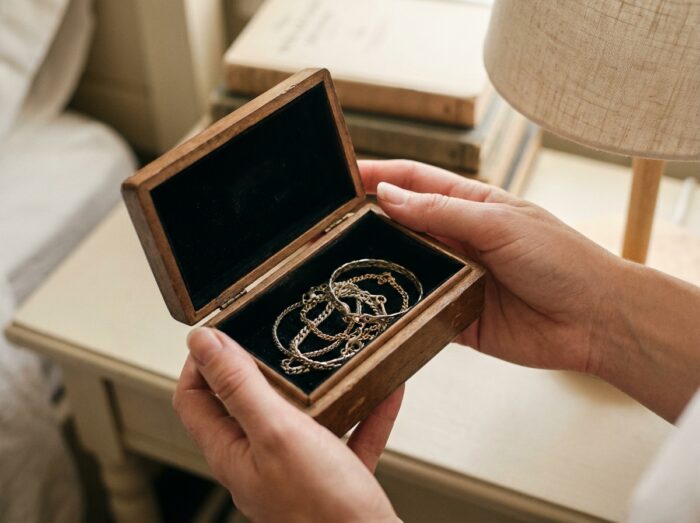
The durability of a thin bracelet is not only determined by wearing it. Stacked or rolled storage accelerates wear due to mutual scratches, knots, and deformation of the links. A 925 silver bracelet stored in an open box oxidizes faster than a bracelet stored individually in an anti-tarnish pouch.
Flat and separate storage remains the most effective method. Individual hook displays, anti-oxidation fabric pouches, or compartments lined with felt protect both the chain and the clasp simultaneously.
A detail often overlooked: contact between different metals accelerates oxidation. Storing a silver bracelet against a gold-plated bracelet in the same compartment promotes a surface galvanic reaction. Separating metals prolongs the shine of each piece.
Choosing a thin bracelet that won’t end up at the back of the drawer
The real selection filter boils down to three questions: what base metal, what type of clasp, what guarantee. A solid 925 silver bracelet with a welded clasp and repair warranty is likely to be worn for years. A bracelet made of an indeterminate alloy, plated to an unspecified thickness, with a clasp without welding, will be forgotten in a few months.
Price is not a reliable indicator. Some moderately priced artisanal pieces use higher quality components than those from brands positioned much higher. The material sheet remains the only document that commits the manufacturer.
A thin bracelet that stays on the wrist rather than in the box is primarily one whose composition is known, whose clasp has been designed to last, and whose storage respects the metal. The rest is a matter of taste, not technique.