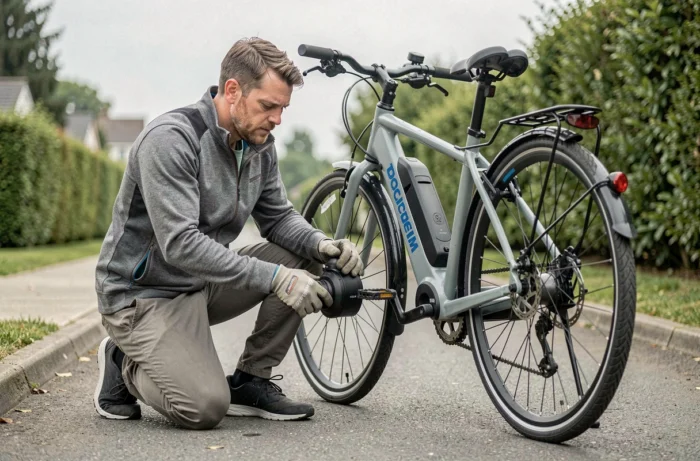
An electric bike from Decathlon that refuses to start or whose assistance cuts out unexpectedly rarely presents an irreparable problem. Most issues with the Elops, Riverside, or Rockrider ranges focus on three areas: the battery, the controller, and the pedal sensor. Before heading to the workshop, a methodical diagnosis often allows for restoring functionality or, at the very least, accurately identifying the faulty component.
Error codes and controller reset protocol on Decathlon bikes
The controller (or ECU) is the component most often overlooked by consumer articles, even though it accounts for a significant portion of assistance failures. On Decathlon models equipped with an LCD screen (B’Twin, Elops 920 E, Riverside 500 E), an error code displayed at startup guides the diagnosis before any mechanical manipulation.
A code related to the speed sensor generally indicates a misplaced magnet on the spoke or a loose sensor at the rear fork. A motor code may indicate a temporary overheating or a disconnection in the wiring between the hub motor and the controller. In both cases, unplugging the battery for several minutes and then reconnecting it can sometimes erase the error and restart the system.
If the error persists after this reset, the problem is hardware-related. We recommend visually checking each connector in the wiring harness, especially those located under the chain guard or along the diagonal tube, where moisture and vibrations can cause false contacts.
Shared feedback on the Gentlemen Drivers forum confirms that the majority of assistance failures on Decathlon models can be resolved by checking the connections before any major intervention.
Decathlon electric bike battery: cell-by-cell diagnosis
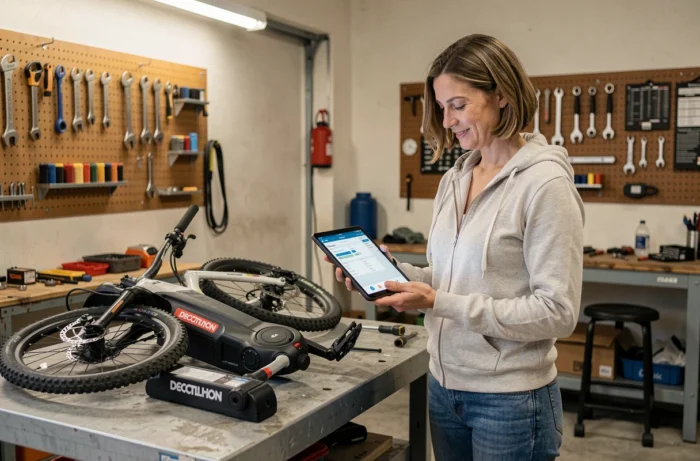
A battery that shows a full charge but no longer delivers current to the motor does not always require a complete pack replacement. An equipped workshop can check the capacity of each cell group separately and the state of the internal electronics (BMS). An imbalance between cell groups, or a locked BMS after a deep discharge, explains most cases of “dead” batteries on Elops and Riverside models.
Deep discharge and BMS locking
An electric bike stored for several months without recharging can drop below the minimum voltage threshold of the BMS. The protection system then permanently cuts off the power to prevent damage to the cells. The original charger can no longer initiate the charge, giving the impression of an irreparable battery.
A technician can reactivate the BMS by applying a controlled reactivation voltage, cell by cell. This intervention costs significantly less than a new pack and extends the battery’s lifespan by several years if the cells have not undergone irreversible chemical degradation.
Compatibility of battery spare parts
The bike model reference takes precedence over voltage or brand when ordering a replacement battery. The Decathlon catalog associates each battery with specific models: a battery compatible with an Elops 920 E may not necessarily fit an Elops 900 E, even if the nominal voltage seems identical. Always check the product reference on the Decathlon support before placing an order.
- Note the complete reference of the bike (label on the frame or purchase invoice) before looking for a battery
- Compare the charging connector and the type of mounting (rail, internal tube, rack) with the offered part
- Prefer official Decathlon catalog parts to maintain the warranty on the rest of the electrical system
Pedal sensor and assistance cuts while riding
Intermittent assistance cuts while pedaling are the most reported symptom on Decathlon city and hybrid electric bikes. The pedal sensor (PAS sensor), located at the bottom bracket, detects the rotation of the cranks and transmits the information to the controller. A misalignment of the ring magnet or a buildup of grease on the magnetic sensor causes micro-cuts in assistance.
Cleaning the PAS sensor with a dry cloth and repositioning the magnetized ring resolves most of these cuts without needing to replace any parts. On Riverside and Rockrider models with a torque sensor, the problem is more complex: a faulty torque sensor requires complete replacement and recalibration by the workshop.
Differentiating PAS sensor and torque sensor
The PAS sensor (found on Elops and entry-level Riverside models) operates in a binary manner: it detects that you are pedaling without measuring the effort. The torque sensor, mounted on higher-end models, measures the pressure applied to the pedals and doses the assistance proportionally.
A faulty PAS sensor results in erratic assistance (jerks, delayed starts). A malfunctioning torque sensor produces either a total lack of assistance or a constant maximum assistance. Identifying the type of sensor on your model guides the diagnosis and prevents ordering the wrong part.
European regulation on batteries: what changes for repairs
The European regulation on batteries requires that for electric bike batteries placed on the market from the date of application, an independent professional must be able to remove and replace the battery. The text also provides for the possibility of replacing individual elements of the pack, rather than only the complete pack.
This regulation also prohibits the use of software that would prevent replacement with a compatible battery from another manufacturer. For Decathlon bike owners, this means that eventually, replacement batteries must remain available for at least five years after the last unit is placed on the market.
This requirement is not retroactive. Bikes already in circulation are not covered by these new rules. For an older model whose battery is no longer in the catalog, refurbishment by a specialist remains the only viable option.
- Check the market release date of your model to see if the regulation applies
- Keep the purchase invoice: it proves the commercialization date in case of a customer service dispute
- For older models, seek a workshop specialized in refurbishing lithium-ion batteries
A faulty Decathlon electric bike can usually be repaired without replacing expensive components. The wiring, the battery BMS, and the pedal sensor account for most malfunctions. Accurately identifying the faulty component before ordering remains the most cost-effective approach.