
A domestic plumbing network relies on two distinct circuits, made from materials that behave very differently depending on pressure and temperature, and a regulatory framework that has evolved recently. Understanding these plumbing basics allows for intervention in routine operations without exacerbating an existing disorder.
Order of September 10, 2021, and backflow protection in domestic plumbing
Since January 1, 2023, the order of September 10, 2021, mandates a protection against backflow at the delivery point for any new or completely renovated internal network. The goal is to prevent pollution from the private installation from flowing back into the public drinking water network.
This text provides exceptions for the private areas of collective housing and individual houses, but the logic remains the same: each supply circuit must include a disconnecting device or a backflow preventer suitable for the risk category of the connected appliance.
In practice, this means that an individual replacing their entire internal distribution must check for the presence of this device downstream of the meter. Public guides rarely mention this obligation, while a lack of compliance can hold the owner liable in the event of contamination. Before starting any installation, we recommend discovering plumbing with Une Autre Maison to establish the necessary technical benchmarks.
Pex, copper, or multilayer: choosing pipes according to actual use
The choice of material determines the durability of the network and the ease of future intervention. Three families cover almost all residential installations.

The Pex pipe (cross-linked polyethylene) has gradually replaced copper in hot and cold sanitary water networks. Its flexibility allows for a seamless path, with crimp or compression fittings. It can be installed in slabs, wall linings, or crawl spaces, making it suitable for various house configurations.
Copper remains relevant for vertical risers and exposed connections because it is more resistant to UV and mechanical shocks. However, its installation by brazing requires specific tools and a skill that Pex does not demand.
The multilayer pipe (Pex-aluminum-Pex) combines the rigidity of metal and the chemical resistance of polymer. It retains its shape after bending, simplifying visible runs. Its weak point: crimp fittings require a calibrated tool specific to each diameter.
- Pex: preferred for embedded distributions, common diameters of 12 to 20 mm depending on the required flow at the draw-off point
- Annealed copper: reserved for visible sections, boiler supplies, and situations where mechanical strength is paramount
- Multilayer: suitable for renovations in visible areas where Pex would lack rigidity, with sealing reinforced by the aluminum layer
Fittings and faucets: points of failure to watch
The majority of domestic leaks come from fittings, not the pipes themselves. Understanding their operation significantly reduces the risk of water damage.
A compression fitting uses a nut and a ring (olive) that deforms against the pipe to ensure sealing. This type of joint is removable, making repairs easier. A crimp fitting, on the other hand, is permanent: once the tool is activated, disassembly requires cutting the pipe.
On the faucet side, each sanitary appliance must have an accessible individual shut-off valve. This basic rule allows for isolating a draw-off point without cutting off the general supply to the house. A shut-off valve stuck due to limescale loses all utility: operating the valves a quarter turn once or twice a year is enough to maintain their mobility.
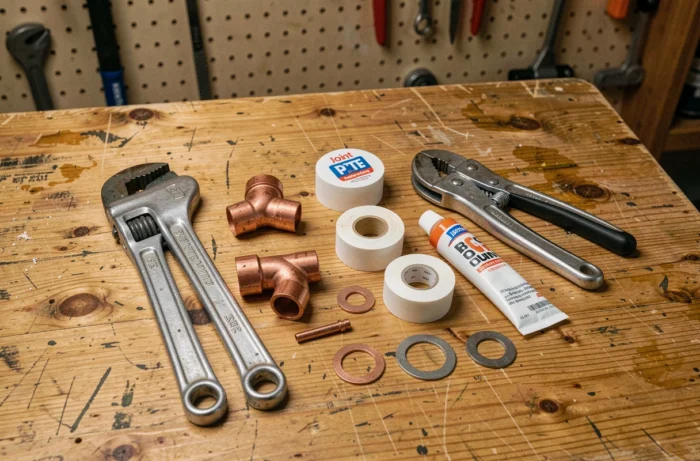
The siphon, often overlooked, plays a direct sanitary role. Its water seal prevents gas from the drainage network from rising. A dry siphon (unused shower, sink in an unoccupied room) allows odors to pass through. Pouring a little water regularly into seldom-used appliances solves the problem without intervention.
Warsmann Law and leaks after the meter: what the device actually covers
In the event of an abnormally high water bill due to a leak on a pipeline after the meter, the Warsmann Law (law no. 2011-525 of May 17, 2011, supplemented by decree no. 2012-1078 of September 24, 2012) allows for a cap under certain conditions.
A leak on a household appliance or sanitary equipment is excluded from the device. Only leaks on pipelines are covered. The owner must provide a repair certificate issued by a professional within the time frame set by the water service.
For a DIYer who intervenes themselves, this limit is significant: a repair not certified by a qualified plumber does not trigger the cap. Keeping the invoice from a professional, even for a one-time intervention, provides financial protection in case of late-detected overconsumption.
Drainage network: slopes, diameters, and primary ventilation
The drainage circuit operates by gravity. An insufficient slope causes recurring blockages that the auger only temporarily resolves. The recommended slope for horizontal pipes is generally between one and three centimeters per linear meter.
Diameters vary according to the connected appliance:
- Sink and bidet: small diameter PVC pipe, sufficient for moderate flow
- Shower and bathtub: intermediate diameter to absorb a larger volume
- Toilet: the largest diameter in the network, directly connected to the drop column
- Vent or primary ventilation: extends the drop column above the roof to balance pressures and prevent siphon disconnection
Without proper primary ventilation, flushing a toilet on the upper floor can suck the water seal from a sink siphon on the ground floor. This phenomenon, called siphoning effect, generates persistent odors that cleaning does not resolve.
Each intervention on the drainage network must respect the flow direction and maintain accessibility of the inspection covers for unblocking. Placing a manhole or cover every few meters, and systematically at each change of direction, remains the best assurance against lasting obstructions.