
In 2023, over 15,000 units of quadruped robots were sold worldwide, far exceeding the manufacturers’ initial forecasts. The adoption of these machines is no longer limited to laboratories or security companies.
Some models, such as the CyberDog 2 or the Unitree As2, are already available to the general public and equipped with advanced features, capable of interacting with humans or integrating into home environments. The boundaries between utility, companionship, and technological objects are being profoundly redefined.
Recommended read : The latest technological innovations and trends to watch in 2024
Surprising capabilities of robotic dogs: how technology is shaping new companions
The landscape of robotics has transformed: robotic dogs no longer just look canine; they come equipped with an unprecedented technological array. Artificial intelligence, sensory sensors, computer vision systems… each robot analyzes its surroundings, adapts its movements, and responds to voice commands or simple gestures. We are witnessing the emergence of true mechanical companions, capable of integrating into daily life and adapting to human behaviors.
Their autonomy is rapidly advancing: facial recognition, emotion interpretation, continuous learning through increasingly sophisticated algorithms. Some models, designed as open source, even invite enthusiasts to customize their robot, enhance its abilities, and shape a tailored relationship between human and machine.
Further reading : Complete guide: how to return, cancel, or claim a purchase at Promod
This movement extends beyond the private sphere. User experiences are multiplying: emotional support for the elderly, mediation in hospitals, reinforcement for surveillance or security. The robotic dog does not replace the living animal; it offers a new type of bond, mediated by technology, and compels us to reconsider the role of artificial intelligence in our daily relationships.
To explore these changes and their implications further, discover Utile au Quotidien for an in-depth analysis of the future of robotic dogs and their impact on our lives.
Unitree As2, Xiaomi CyberDog 2, and others: a panorama of models shaking up the market
In recent years, quadruped robots have taken center stage in the technology scene. Models like the Unitree As2 or the Xiaomi CyberDog 2 combine sleek design, responsiveness, and integration of cutting-edge sensors. Capable of walking, running, or overcoming obstacles with disconcerting mechanical fluidity, they now venture into areas where balance is crucial, on unstable terrain, showcasing technical feats.
Their performance relies on an articulated structure and four motorized legs, supported by a suite of embedded analysis technologies. Thanks to computer vision and sensors, every contour of the ground, every change in context is detected and processed in real-time. This responsiveness opens the door to unprecedented applications: search, rescue, home assistance… quadruped robotics is making its way into any area where adaptability and mobility are required.
China, undoubtedly, has been setting the tone since the early 2020s. Manufacturers are betting on open source and encouraging developers to push the boundaries of embedded artificial intelligence. A hybrid ecosystem is taking shape, blending pets and technological assistants, ready to settle into our homes and profoundly transform our relationship with living beings.
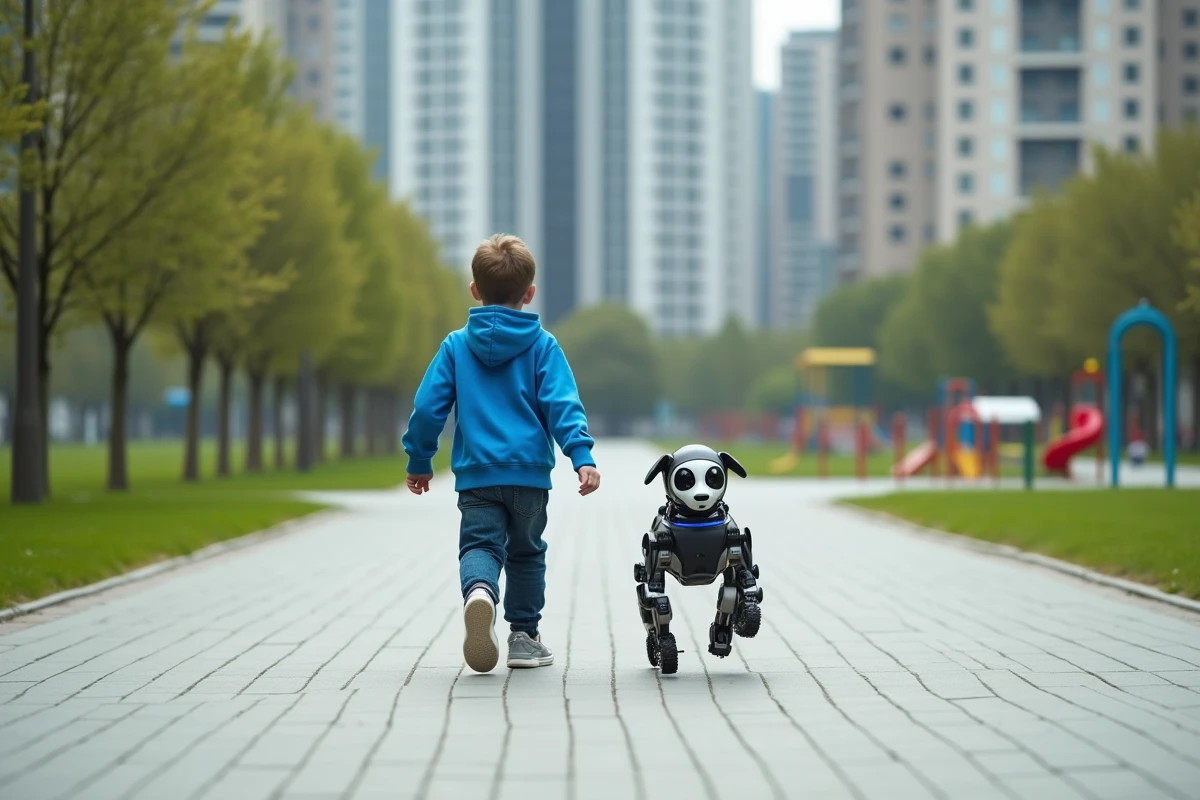
Animal robots in our homes: what challenges for society and our relationship with living beings?
The presence of animal robots at home questions the boundary between technology and nature. The domestic companion is no longer limited to a living creature: the machine inserts itself into the intimacy of families, sometimes as a pet, sometimes as support against loneliness or to provide emotional assistance. Some robots, equipped with highly sophisticated vision systems and sensors, adjust their reactions based on the environment and human attitudes, blurring the distinction between living beings and artifacts.
It is impossible to ignore the ethical dimension. The use of a robotic dog in therapies, with autistic children or the elderly, raises both hopes and reservations. Can we truly entrust the role of social or emotional mediator to an artificial being? Can a relationship, even enriched by artificial intelligence, come close to the authenticity of a biological bond?
Another point of concern is digital security and privacy. These robots, filled with microphones and cameras, constantly collect and process personal data. A cybersecurity flaw could lead to leaks and endanger users’ privacy.
Here are some concrete aspects emerging with the arrival of animal robots in homes:
- Co-evolution of domestic environments, now shared between humans and artificial intelligences
- Transformation of the role of traditional pets, faced with the competition of increasingly interactive machines
- Possible effects on the social and emotional development of children, exposed early to these new forms of companionship
The robotic dog is entering daily life, creating confusion in our references and forcing us to rethink the connection between humans, animals, and machines. The next generation of companions may not come wagging their tails, but they will likely knock on the door with a bright gaze and an unprecedented promise: that of a new type of presence, between code and cuddles.